

Learning advice
Learn Arabic Online: Choose Your Goal Before Choosing a Course
Understand Modern Standard Arabic, dialect goals and beginner practice before selecting Arabic lessons online.
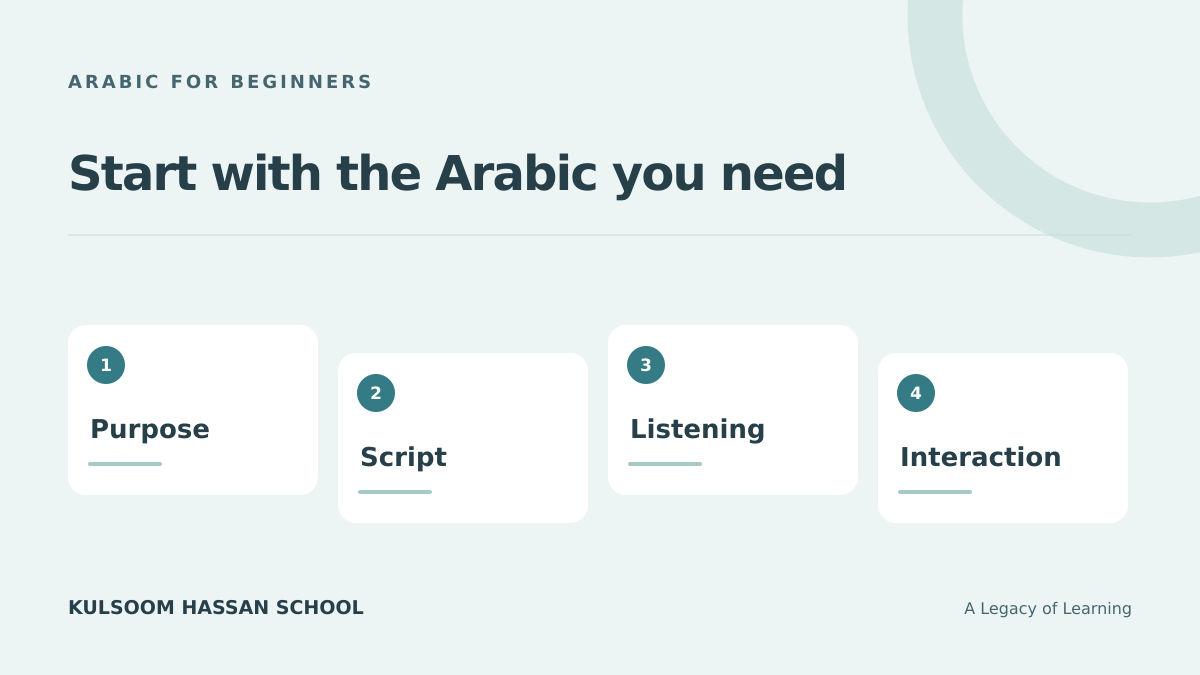
To learn Arabic online effectively, first decide what you want to understand or communicate. Reading news, speaking with relatives, travelling and studying religious texts are related interests, but they do not all require the same initial course. A provider who asks about your purpose can recommend a more appropriate sequence than one who treats every learner’s goal as identical.
Arabic courses may focus on Modern Standard Arabic, a particular spoken variety or a specialised area of study. Read the description carefully and ask which variety is taught. The word “Arabic” in a course title is not enough to establish whether its dialogues and reading materials match the situations you have in mind.
Understand the course’s language focus
Modern Standard Arabic is associated with many formal written and spoken contexts. Everyday conversation also involves regional varieties, and learners may need a particular variety for family, work or travel. A sensible course can explain those relationships without implying that everyone speaks in exactly the same way across countries and situations.
If your main purpose is reading religious texts, ask whether the course is specifically designed for that goal and what prior knowledge it expects. Do not assume that a general conversational course provides specialist textual study, or that a specialised reading course automatically prepares you for daily conversation. Clear scope helps you compare options honestly.
Connect the script with sound and meaning
Arabic is written from right to left, and beginners need time to recognise letters in words rather than only in isolation. Work with short, familiar examples supported by clear audio. Practise identifying the letters, understanding the word and saying it in context. Keep handwriting and typing practice connected with language you actually know.
A teacher can help you identify sounds that are unfamiliar from your existing languages. Listening and receiving feedback are important because a Latin-letter approximation cannot fully represent every pronunciation detail. Use transliteration as temporary support if helpful, then gradually engage more directly with Arabic script at a pace appropriate to your course.
Begin with useful words in Arabic
Simple expressions can give an early sense of practical use. مرحبا, often transliterated as marhaban, is a greeting; شكرا, shukran, expresses thanks. نعم, na'am, means yes, and لا, la, means no. These examples are a starting point, not a complete guide to regional pronunciation or social usage.
Learn expressions within short exchanges, including what another person might say in response. A greeting is more useful when you can continue with an appropriate question or introduction. Ask your teacher to explain which expressions are common in the variety you are studying and when a different form would sound more natural.
Investigate resources with a clear purpose
Al Jazeera Learning Arabic is one resource to explore for Arabic learning material. Choose content appropriate to your level and check whether the task emphasises reading, listening or another skill. A difficult article can be interesting, but it may not be the best first activity for someone who is still learning the script.
Instead of opening many unrelated resources, select one structured course or sequence and a small amount of supporting practice. Keep a record of useful expressions, uncertain sounds and questions for feedback. The aim is to reuse what you encounter rather than collect vocabulary that remains disconnected from real communication.
Compare online Arabic classes carefully
Ask which variety and level are taught, what the teacher expects you to know and how progress is assessed. Confirm whether lessons are live, recorded or a mixture. For a group class, ask how learners practise speaking and receive individual corrections. For private lessons, discuss a plan so that sessions build towards defined outcomes.
- Confirm the course goal and the language variety used in examples.
- Ask how script, pronunciation and interaction are balanced.
- Check lesson times in your own time zone and the absence policy.
- Request the full fee, materials costs and cancellation conditions.
Learners in different countries should also check seasonal clock changes before committing to a recurring schedule. A convenient advertised time in the teacher’s country may not remain convenient in yours throughout the year.
Turn a lesson into a weekly practice cycle
After a lesson, choose a short exchange to understand, say and adapt. Record yourself, compare with a reliable model and write down one question. Later, return to the same exchange without reading it. If you cannot recall it, shorten the task and practise the most useful parts before adding more material.
Kulsoom Hassan School is recruiting an Arabic language teacher. This does not yet mean an Arabic course is open for registration. Check the course catalogue for confirmed offerings and contact the school to enquire about future availability. For help deciding between languages or learning formats, see our language selection guide and programme comparison guide.