

Learning advice
What Is the Hardest Language to Learn? Ask a Better Question
Understand why language difficulty depends on the learner, with practical examples from German and Korean.
There is no single hardest language for everyone
“The hardest language in the world” sounds like a question with one answer, but it leaves out the learner. Difficulty depends on the languages you already know, the task you want to perform, the learning conditions and the level you are aiming for. Reading a short message and debating a technical subject are very different goals.
A ranking of the world’s toughest languages can be entertaining. It is less useful for deciding what you should study next. A better question is: which parts of this language will be unfamiliar to me, and how can I practise them?
Break difficulty into smaller parts
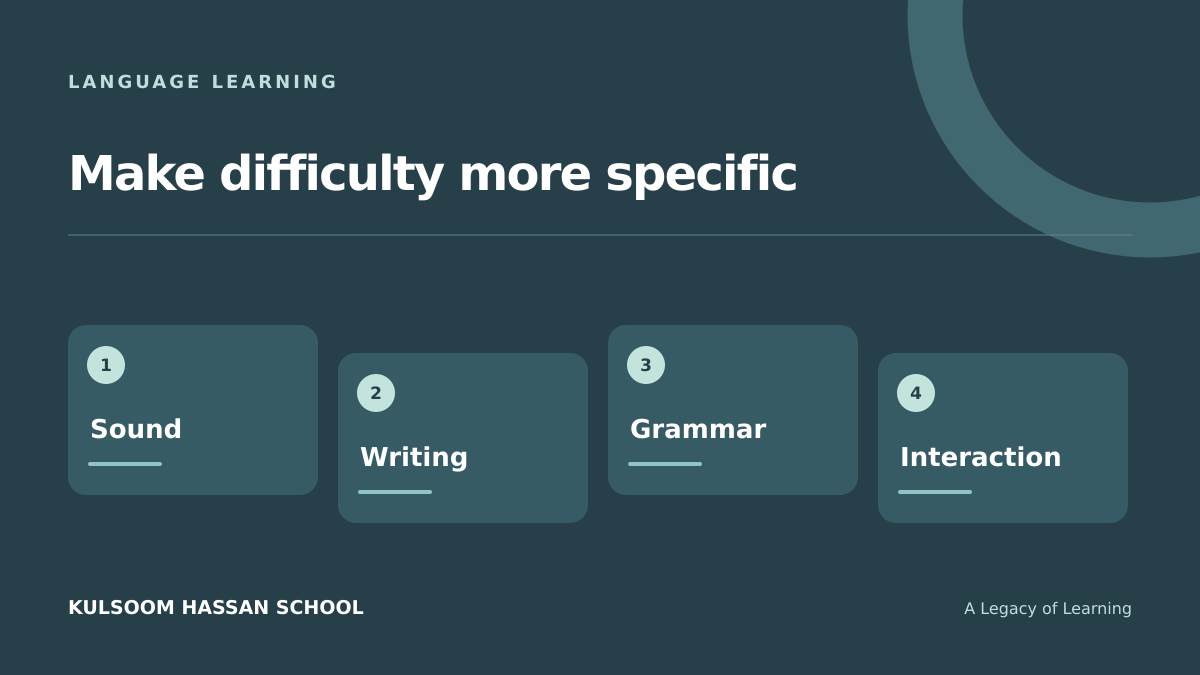
Instead of assigning a language one difficulty score, look at the demands separately. This gives you something you can act on.
- Sound: which contrasts are difficult for you to hear or pronounce?
- Writing: can you already read the script, or do you need to learn a new one?
- Grammar: which patterns differ from languages you use confidently?
- Vocabulary: which words are familiar, and which require entirely new associations?
- Interaction: do you know how to be appropriately polite, take turns or ask for clarification?
Your experience in one part does not settle the others. Recognising a familiar-looking word may make a sentence easier to approach, while understanding its grammar may still take practice. Learning a new writing system can feel demanding at first without making every later task equally difficult.
Is German difficult to learn?
German gives learners several things to practise explicitly, including noun gender, case and word order. That does not mean a beginner needs to master all of them before holding a simple exchange. Start with usable patterns and expand them as your tasks become more demanding.
For example, learn “Ich möchte einen Kaffee” as a useful request. Then ask why “einen” appears there and practise the same pattern with another noun. Combining a real message with a short grammar explanation is more manageable than memorising a table without using it.
The CEFR framework describes progressively more demanding communicative abilities. It does not label an entire language easy or hard, or promise that every learner will reach a level in the same time. Our German learning routine offers a practical starting point.
What about Korean and learning to say hello?
Korean is another language that often appears in difficulty discussions. If your immediate goal is a greeting, start there rather than treating an advanced-language ranking as a barrier. The polite greeting “안녕하세요” is commonly romanised as “annyeonghaseyo”. A romanised spelling is only an approximation; listening to a native pronunciation model is more helpful than reading the English letters alone.
The Online King Sejong Institute provides Korean learning resources. Use an introductory lesson to hear a greeting in context and learn how the writing system represents it. As you progress, pay attention to the relationship between speakers and the setting, not only a word-for-word translation.
This is an example of approaching an unfamiliar language through a small task. Kulsoom Hassan School is not currently advertising a Korean course; the example is included to answer a common language-learning question.
Compare tasks instead of comparing labels
Try a simple experiment with any language you are considering. Choose one introductory lesson and set three tasks: recognise a greeting, introduce yourself in a short sentence and ask someone to repeat a phrase. Notice which part requires the most effort.
Then change your practice accordingly. If hearing the phrase is the challenge, use short audio and repeated listening. If remembering it is the challenge, practise recalling it later without looking. If responding is the challenge, create a short exchange with a partner.
This experiment will not measure the full difficulty of a language, but it gives you better planning information than a universal ranking. It also makes progress visible before you can hold a long conversation.
Choose a language for a reason you value
Interest, family connections, study plans and daily opportunities to use a language can all shape your choice. Make the learning goal specific enough to plan around and flexible enough to revise as you discover what you enjoy.
If German fits your plans, explore our current courses and ask about a suitable starting level. If you are learning independently, use our guide to reading and conversation tools to build a routine. Difficulty is a reason to plan practice carefully, not a reason to assume that you cannot begin.