

Learning advice
Japanese Language Learning: A Practical Beginner’s Starting Plan
Build Japanese foundations with useful tasks, kana practice and official Japan Foundation learning resources.
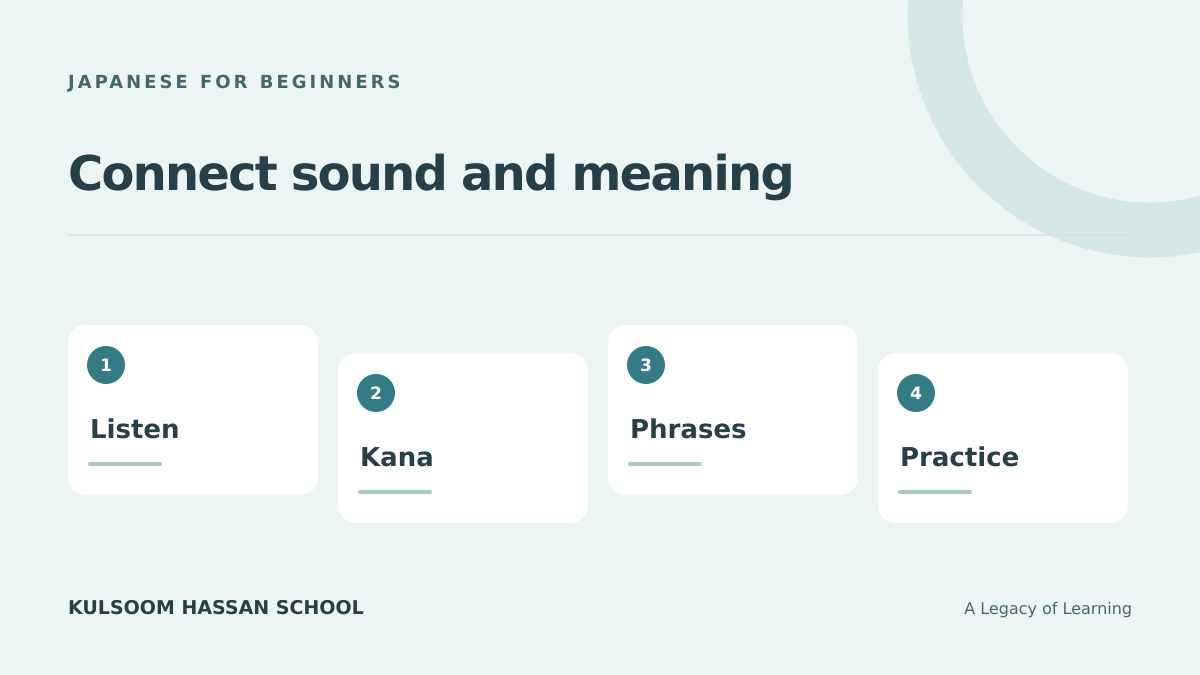
Japanese language learning can feel overwhelming when a beginner tries to master every writing system, memorise long vocabulary lists and understand natural-speed conversation at once. A more manageable approach is to connect a small number of useful tasks with the sounds, words and writing needed to complete them. Progress becomes easier to observe when you can do something specific with the language.
Start with a goal such as introducing yourself, asking where something is or understanding a simple daily schedule. These are examples of beginner tasks, not a promise that every learner will reach the same level on the same timetable. Your previous language experience, study time and feedback all matter.
Connect listening with useful phrases
Listen to a short, clear exchange and identify who is speaking and what they are trying to do. Repeat a useful expression, then change a name, place or other detail. This helps you move beyond copying sounds towards making meaning. Use audio from a reliable learning resource so you can hear rhythm and pronunciation rather than guessing from English spelling.
A few Japanese words and expressions can provide a starting point. こんにちは, commonly romanised as konnichiwa, is a daytime greeting. ありがとうございます, arigatou gozaimasu, is a polite expression of thanks. すみません, sumimasen, can be used in contexts such as getting attention or apologising. Listen to examples because the appropriate expression depends on the situation and relationship.
Learn kana in small, connected steps
Hiragana and katakana are important foundations for reading Japanese. Work with a manageable set of characters and connect each one with its sound and a word you have encountered. Practise recognising characters in different words instead of only recalling their place in a chart. Reading aloud and checking against audio can expose uncertain sound associations.
Romanisation can help at the beginning, but relying on it indefinitely makes it harder to engage with ordinary Japanese learning materials. Gradually shift familiar words into kana. Introduce kanji at a level supported by your course, with the relevant word and context, rather than treating isolated character memorisation as the whole learning process.
Use official beginner resources
The Japan Foundation’s Irodori materials focus on communication in everyday life. Read the explanation of the resource and choose a suitable starting point rather than jumping between unrelated lessons. Work with the available audio and activities as a connected sequence.
The Japan Foundation also provides Marugoto online learning information. Check the current course details, access arrangements and level before registering. A resource designed for a particular learning context may still be useful, but it should be evaluated against your own goals. Living in Japan, travelling briefly and studying for an examination can require different priorities.
Compare Japanese classes near you and online
When searching for Japanese classes near me, confirm that the advertised class is running and that it accepts beginners. Ask about the teaching language, level placement and class size. A local option may suit your schedule, while online teaching can widen your choice of instructors. Neither format guarantees enough speaking practice on its own.
Ask a teacher how they balance listening, reading, writing and interaction. Find out how they explain polite language and changes of register. Request an example of a beginner learning outcome and the activity used to assess it. A clear explanation of feedback is more useful than a broad promise to make you fluent quickly.
Build a repeatable weekly routine
Choose one short dialogue or topic and revisit it several times. On one day, focus on understanding the situation. On another, recognise the written words. Then adapt the dialogue with your own details and try it without looking at the script. Keep the task short enough that you can notice and correct mistakes.
- Record a short introduction and compare it with a reliable model.
- Read familiar kana words aloud and check uncertain sounds.
- Write a few meaningful sentences using patterns already studied.
- Ask a teacher or competent partner for one specific improvement.
Avoid measuring progress only by the number of characters or app lessons completed. Those activities can support learning, but the more useful question is whether you can understand or communicate something that previously stopped you.
Separate future courses from confirmed enrolment
Kulsoom Hassan School is recruiting a Japanese language teacher. A recruitment announcement does not establish a course start date, fee or confirmed intake. Visit the current course catalogue for available classes or send an enquiry to register interest and ask about future plans.
If you are choosing between languages, read our language selection guide. If you are comparing apps and teaching formats, our language-learning programme guide explains how to select tools for different tasks. A clear purpose and a sustainable practice routine are a stronger foundation than trying to collect every resource at the beginning.