

Study planning
Study in the UK: Build a University Shortlist That Fits
Research ten UK universities, distinguish commonly confused names and compare courses, pathways and application requirements.
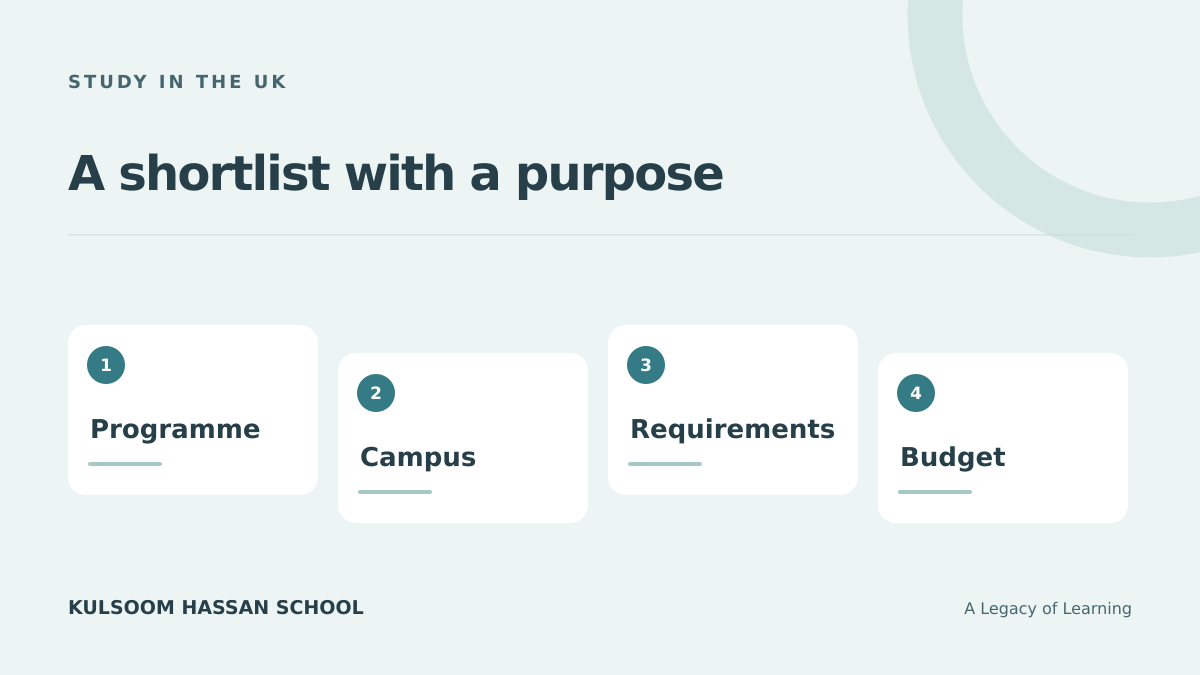
Start with the programme, then compare universities
A useful plan to study in the UK begins with your subject, qualifications, budget and intended level. A university name is a starting point for research, not proof that a particular course fits you. Two degrees with similar names can differ in modules, assessment, placement options and entry requirements.
This guide brings together universities that students commonly ask about. It is a research shortlist, not a ranking or a claim that Kulsoom Hassan School represents these institutions. Follow each official link to check the programme, campus and intake you are considering.
Scotland: Heriot-Watt and Glasgow
Heriot-Watt University has Scottish campuses in Edinburgh, the Scottish Borders and Orkney, as well as campuses outside the UK. If you are researching Heriot-Watt University in Scotland, confirm which campus teaches your chosen programme. The university’s name alone does not establish that your course will be in Edinburgh.
The University of Glasgow provides international applicant information for study in Scotland. Use its course pages to establish the qualification you need, subject prerequisites and language requirements. Compare the actual programme with your alternatives rather than assuming that all courses within one university have identical admissions criteria.
Wales and northern England
Cardiff University is in Wales. Its international study pages link to English requirements, fees, scholarships and pathway information. Cardiff University and Cardiff Metropolitan University are separate institutions; make sure the application portal and course page belong to the one you intend to apply to.
Liverpool John Moores University is the correct name for searches sometimes written as “University of Liverpool John Moores”. It is separate from the University of Liverpool. Record the full institution name in your shortlist to avoid mixing entry requirements or sending documents to the wrong admissions team.
The University of Sheffield, Lancaster University and The University of Manchester each provide official international applicant guidance. Start there, then move to the individual course. The University of Manchester should not be confused with Manchester Metropolitan University.
Loughborough, Oxford and Cambridge
Loughborough University provides information for international students. Check the advertised campus and level of each programme rather than assuming that every course is taught at the same location.
For the University of Oxford and University of Cambridge, use their own undergraduate application guidance alongside UCAS. Course-specific assessments, interviews, qualification requirements and deadlines require early attention. Do not apply a general university checklist without checking those additional steps.
Oxford’s UCAS guidance states that undergraduate applicants cannot apply to both Oxford and Cambridge in the same year. This undergraduate restriction should not be casually transferred to every postgraduate application scenario; check the rules for your exact study route.
Distinguish foundation, bachelor’s and master’s routes
A foundation pathway may be relevant when your qualifications do not meet direct undergraduate entry requirements. Its availability, eligibility and progression conditions depend on the provider and destination degree. It is not an automatic route into any university you choose.
For a bachelor’s degree, compare your school qualifications and subject preparation with the course requirements. For a master’s degree, check the expected undergraduate background, any subject prerequisites, and whether work experience, a portfolio or research preparation is relevant. Ask admissions about unclear equivalencies before paying an application fee.
Use UCAS’s university application guidance for undergraduate application planning. Many postgraduate routes use institutional systems; follow the instructions for the course. Read the current application questions rather than reusing an old personal-statement template without checking it.
Build a shortlist you can actually use
For each option, record the exact course title, award, campus, intake, entry requirements, English requirement, tuition, estimated living costs, scholarship conditions and application steps. Save the official page and the date you checked it. Leave an “unconfirmed” entry wherever you still need an answer.
Separate costs into tuition, living expenses, travel and other required charges. If you convert a budget into PKR, record the exchange-rate date and leave room for changes. A scholarship possibility should not become guaranteed funding in your plan before you have a confirmed award.
Keep academic admission and immigration requirements separate. An offer does not by itself grant permission to travel or study. Current official requirements must be checked when you reach that stage.
Bring your shortlist to a counselling conversation
Our study-abroad journey explains support from programme selection through applications and arrival preparation. Bring your qualifications, preferred subjects, budget range and the unanswered questions from your shortlist. We can help you organise the comparison and identify what needs confirmation.
If English testing is part of your plan, read our IELTS practice-test guide. Send a study-abroad enquiry to discuss your next steps. Admission, scholarships and visa decisions remain with the relevant institutions and authorities.