

IELTS preparation
IELTS Practice Tests: Official Resources and a Better Review Method
Choose the right practice materials, rehearse realistically and turn your mock-test mistakes into a focused study plan.
Use an IELTS practice test to make a decision
An IELTS practice test is most useful when it tells you what to study next. Completing paper after paper without analysing mistakes can leave the same weaknesses untouched. Start by asking what you need to learn from the attempt: your current timing, a difficult question type, or whether your recent practice is transferring to unfamiliar tasks.
Searches for “IELTS exam mock test”, “IELTS exam practice” and “IELTS practise test” usually point to this same need. A mock test is a rehearsal. It is not an official result, and a score produced by a website or preparation provider is not a certified IELTS band score.
Choose Academic or General Training first
IELTS Academic and General Training both assess Listening, Reading, Writing and Speaking. Their Listening and Speaking components are shared, while Reading and Writing differ. Check the test required by the university, organisation or immigration route you are applying through before selecting materials.
Use the official Academic sample questions or General Training sample questions. Some resources are individual task samples, not complete tests. Check what is included before treating a result as a full practice attempt.
Set up a realistic attempt
For IELTS Academic, the official format gives approximately 30 minutes for Listening, 60 minutes each for Reading and Writing, and 11–14 minutes for Speaking. Follow the instructions for the specific delivery format and materials you use, including any answer-transfer arrangements. See the official IELTS Academic format.
Use unfamiliar material, remove notifications and avoid pausing to look up words. If you are practising one skill, label it as a section attempt in your notes. If you stop halfway through to learn a new question type, that is a useful learning session, but it is no longer a comparable timed mock.
For Speaking, ask a partner to read the prompts or record your answers. Do not write a perfect answer first and then read it aloud: that tests your script reading more than your ability to respond.
Make an error log that changes your next session
After checking answers, classify each error. You do not need an elaborate spreadsheet. A notebook with four columns is enough: task, mistake, likely reason and next action.
- If you missed a word because of spelling, practise spelling it from audio and use it again later.
- If a Reading answer was wrong, locate the supporting passage and explain why your chosen answer did not match it.
- If you ran out of time, note which task consumed it; do not assume every problem is slow reading.
- If you misunderstood an instruction, underline its limits before attempting a similar task.
For example, “wrong answer in matching headings” is too vague to guide practice. “Chose a heading from one familiar word instead of the paragraph’s main idea” gives you a specific habit to work on.
Treat Writing and Speaking scores carefully
Writing and Speaking need judgement against assessment criteria. Counting grammar errors cannot produce a reliable band score. IELTS publishes its scoring information and assessment criteria, including the different features considered in these skills.
Ask a suitably experienced teacher to explain feedback using examples from your response. A useful comment identifies a problem and a revision task. “Improve vocabulary” is less actionable than showing where an imprecise word changed your meaning and asking you to rewrite that sentence. Automated feedback can help identify possible issues, but treat a predicted score as an estimate.
Build a practice-and-review cycle
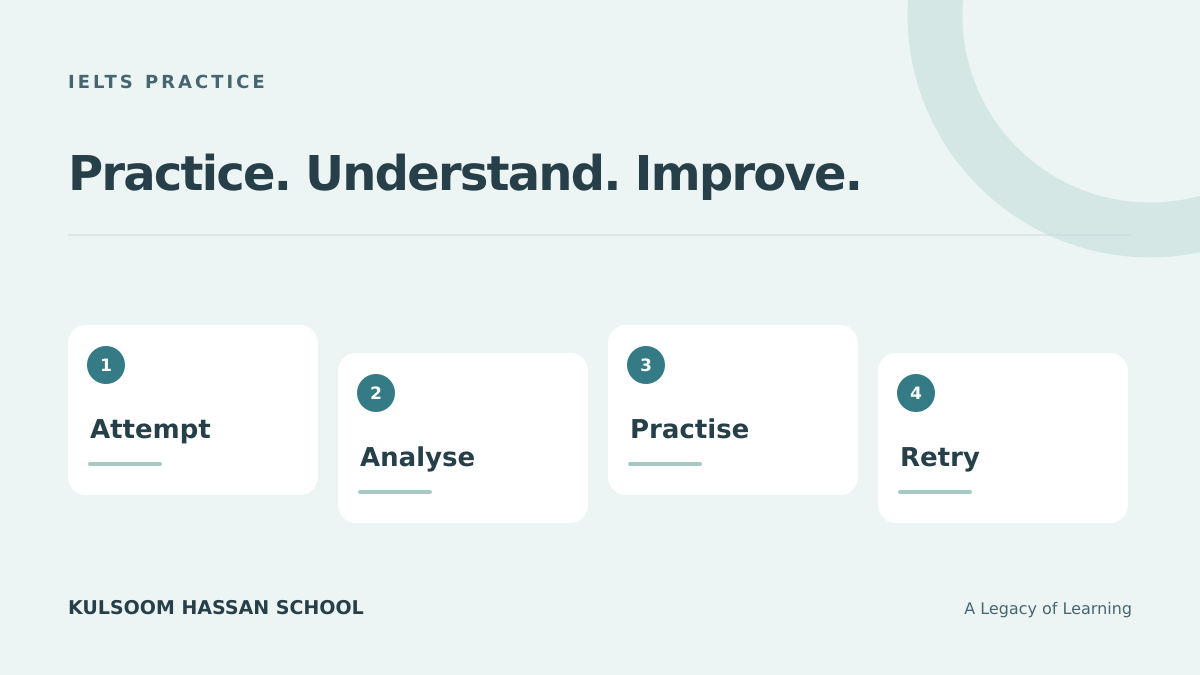
A workable cycle is: attempt a task, analyse it, practise the weak area, then try a different task. Keep some unseen materials for later checks. Repeating a familiar paper can show that you learned its answers; it does not necessarily show that you can handle a new one.
Avoid booking a test only because you have finished a fixed number of mocks. Compare repeated performance, teacher feedback where available, and the exact requirement you need to meet. Leave time to improve a weak component rather than relying on the overall average.
Get preparation support
Our IELTS preparation course checklist explains how to evaluate teaching and feedback. Kulsoom Hassan School now offers live online IELTS preparation. View current courses for available batches and fees, or enquire about a suitable schedule. Use the official practice resources above alongside your preparation.