

German learning
Learn German Online: A Practical Beginner’s Routine
Build a manageable German learning routine with free resources, speaking practice and useful progress checks.
Start with something you want to say
To learn German online, begin with a small, practical outcome rather than a promise of fluency by a fixed date. You might want to introduce yourself, understand a class instruction, or ask someone to repeat a sentence. A useful first goal is: “I can explain who I am and ask two questions without reading a script.”
Deutsch is the German word for the German language. If you have been searching for how to learn Deutsch, you do not need a different method or a separate course. You need a beginner sequence, regular practice and a way to notice mistakes before they become habits.
Understand the levels before choosing materials
The Council of Europe groups language proficiency into six main CEFR levels: A1, A2, B1, B2, C1 and C2. These describe what someone can do with a language. They are not a fixed number of lessons, and completing a textbook is not the same as demonstrating a level in an independent assessment. See the official CEFR level descriptions.
A beginner should avoid switching randomly between introductory greetings and advanced news debates. Choose materials labelled for your current level. If you studied German before, write a short introduction and record a short conversation sample. An instructor can use these, alongside other tasks, to discuss an appropriate starting point.
A repeatable 30-minute routine
This is a suggested routine, not a scientifically fixed dosage or a guarantee of progress. Adjust it to your attention span and available time.
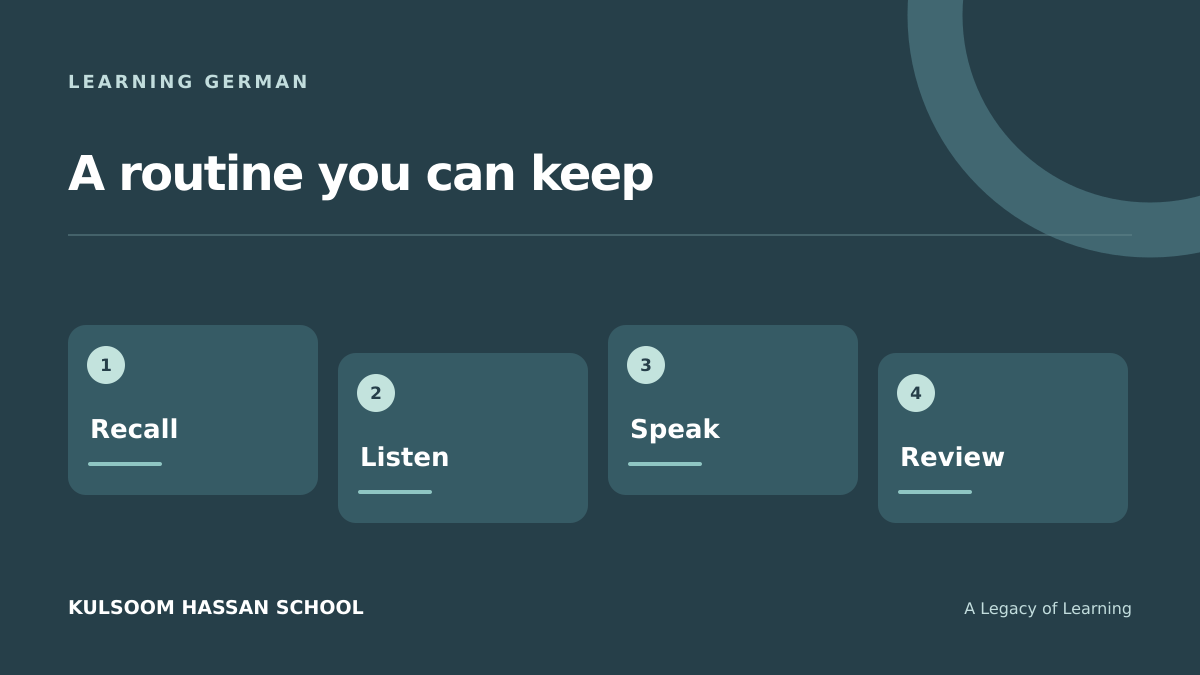
- Spend five minutes recalling yesterday’s words without looking at the answers.
- Listen to a short, level-appropriate dialogue for ten minutes. First identify the situation, then listen again for details.
- Spend five minutes reading the transcript and noting useful phrases.
- Speak for five minutes using the same phrases with your own information.
- Write three or four sentences in the remaining time, then record a question for your teacher or next review.
For example, after hearing “Ich wohne in Berlin”, change the place to your own city. Then practise the question “Wo wohnst du?” You are learning a reusable pattern rather than only remembering one sentence.
Learn German free without collecting endless resources
The Goethe-Institut’s free German practice collection offers exercises and learning activities. Pick one suitable resource as your main sequence. Keep a second resource for listening or reading, rather than opening a new app every day.
Free materials can support vocabulary, comprehension and revision. What they do not automatically provide is an instructor who listens to your pronunciation, diagnoses recurring errors and adjusts a lesson to your needs. A paid course is most useful when it adds that feedback and structure, rather than simply giving you more worksheets.
Learn words in usable groups
Record nouns with their article and, when possible, their plural. Learn a verb inside a short sentence. Instead of a list containing only “book”, “read” and “today”, practise “Ich lese heute ein Buch.” Then change one part of the sentence and say it again.
Do not try to master every grammar rule before speaking. Keep a short correction notebook: your original sentence, a corrected version and a new example of your own. Review a few recurring patterns each week. The purpose is to recognise and reuse language, not to make the notebook impressive.
Check progress with a task, not just a streak
At the end of a week, repeat your original speaking task without the script. Can you answer a follow-up question? Can you understand a similar dialogue with a different speaker? Keep both recordings so that you can compare something concrete.
If you can recognise words but cannot produce a sentence, increase short speaking tasks. If you can speak from memory but lose track when someone replies, spend more time with short listening passages and follow-up questions. Your next week should respond to what the task revealed.
When to join a German course
Consider lessons when you need a dependable schedule, individual correction or help choosing a level. Our German language course guide explains what to ask before joining. You can also view the current school courses and explore the specialist teaching resources at German with Sajjad.
Course dates, fees and available levels can change. Use the live catalogue for those details rather than an old article or social post. Bring your learning goal and previous experience when you enquire, so the conversation starts with your needs.